
On journalistic "objectivity"
TLDR: Don't ever write an op-ed

“You open the newspaper to an article on some subject you know well… You read the article and see the journalist has absolutely no understanding of either the facts or the issues. Often, the article is so wrong it actually presents the story backward…You read with exasperation or amusement the multiple errors in a story, and then turn the page to national or international affairs, and read as if the rest of the newspaper was somehow more accurate about Palestine than the baloney you just read. You turn the page, and forget what you know.”
—Michael Crichton, coining the concept of the Gell-Mann Amnesia Effect
A few years ago, I designed and taught a course at Colorado College titled “The History and Future of American Journalism.” One of the underlying themes was that many contemporary media debates are just new versions of age-old ones.
For example, my students were tasked with debating whether Ben and James Franklin’s anti-inoculation newspaper should be allowed to publish, in the context of calls at the time for Joe Rogan to be removed from Spotify for spreading COVID misinformation. At a time when there was debate about what language about gender transition was potentially “dangerous,” we debated how journalists like Ida B. Wells should be handled given that the widely accepted conventional wisdom of her time was that her defenses of black men were societally corrosive and dangerous. It remains my favorite class I’ve ever taught.
On the first day of the course, I asked students to raise their hand if they’d ever had the experience of something that happened in a community they are a member of -- their childhood school, their neighborhood, their sports team, their place of worship -- covered by the press. Every hand shot up.
Next, I asked them what they, and other members of the community, had thought about the coverage. The negative experience was near universal. Coverage got basic details wrong. Articles were written that included facts, but missed context or understanding. Implications were made or malfeasance suggested only for there never to be any followup. Someone who had consumed the press coverage, my students said, was given an inaccurate understanding of their community, and in some cases even of the specific incident being covered.
For their final paper, each student was tasked with creating a proposal for a media outlet and detailing a plan for how it would create coverage that engenders broad trust -- a challenge facing the free press since its inception and a goal that very well may be impossible.
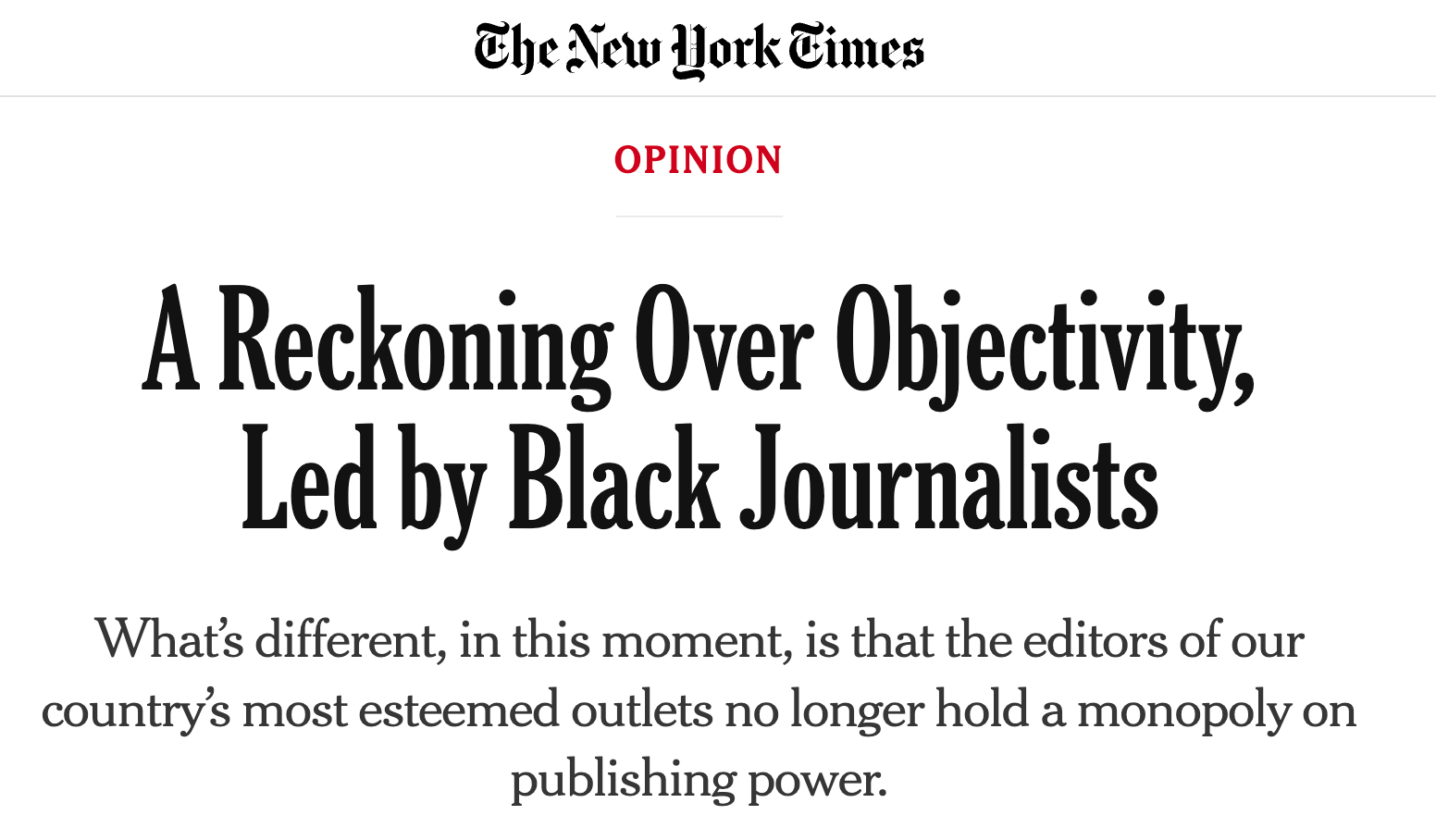
Back in 2020, I wrote an op-ed for the New York Times explicitly endorsing the practice of journalistic objectivity. The lodestar of our journalism, I wrote, should be a devotion to being “fair and telling the truth, as best as one can, based on the given context and available facts.”
These sentences may surprise you, given that in the last six years I’ve been made the poster child for “young internet journalists who don’t believe in objectivity.” Essays, book chapters, and academic reports have been written to rebut my supposed demand that objectivity be “replaced.”
But what if I told you that such a call never happened?
Let’s revisit what I wrote: Journalists “should devote ourselves to accuracy,” “diligently seek out the perspectives of those with whom we personally may be inclined to disagree” and “ask hard questions of those with whom we’re inclined to agree.” As I would later detail in a followup piece, objective journalism requires specific values be embedded in our reporting process, editing decisions, and final product: rigor, fairness, nuance, complexity and clarity.
“The best of our profession already does this,” I wrote in the Times. “But we need to be honest about the gulf that lies between the best and the bulk.”
That is not to say that the piece did not include critique. What I wrote then, and reiterate now, is that the journalistic establishment claims objectivity yet routinely abandons its own standards when the subject is race, power, or the legitimacy of journalists who are unlike themselves.
The term “objectivity” long ago became corrupted and often functions primarily as a marketing device and writing style used to signal “neutrality” -- which is not a requirement of objective journalism.
For example: As I write this essay it is raining in Washington D.C. where I live. My reader should not walk away feeling “neutrally” about what the factual evidence says about whether or not the ground outside my home is currently wet. Nor is the aim of my writing to earn favor from or approval of the politically powerful Anti-Precipitation Lobby. Objective journalism clearly communicates the best obtainable version of the truth, with all of its nuance and in all of its complexity (It has not been raining all day, this is one of those flash summer storms that shows up in a rush, falls hard and intense and then suddenly stops). We do so even if some of our readers do not like that truth, nuance or complexity.
Unfortunately, such deliberate and rigorous work is far from the norm. I wrote about the “professed objectivity” that has dominated mainstream American journalism for a century, and tied the failure of the media to match its marketing directly to its refusal to employ a staff diverse enough to result in journalism that reflects the fullness and complexity of objective reality.
As I had previously told Nieman back in 2015:
“A newsroom cannot tell stories…—at least they cannot tell them thoroughly and with nuance—if you don’t have people who look like the people who are being written about in these stories doing some of the reporting and making some of the coverage decisions from the newsroom. Media diversity is not some type of progressive ideal. It’s a journalistic imperative for any outlet devoted to fairness and accuracy.”
Instead of building diverse staffs that can produce a news report reflective of the full, messy, symphonic nature of objective reality, mainstream journalism has spent decades preoccupied with preferences of an audience it perceives as white, middle-to-upper class, politically moderate, sensibly establishmentarian and dispositionally suburban. Everyone else encounters coverage divorced from their experience of reality and thus deems it untrustworthy. Many of us constantly read articles that fundamentally misstate the facts and contexts of subjects and instances about which we have direct knowledge, insight or experience.
Because American newsrooms have refused to meaningfully racially integrate, the journalism termed “objective” is often drenched in the bias of American status quo whiteness. “The views and inclinations of whiteness are accepted as the objective neutral,” I wrote in the Times. “When black and brown reporters and editors challenge those conventions, it’s not uncommon for them to be pushed out, reprimanded or robbed of new opportunities.”
Race, of course, is a societal construct. That said, because we live in a racialized society, there is in fact such thing as “whiteness,” just as there are things such as “masculinity” or “Christianity” -- broad categories whose memberships include shared experiences, biases, and inclinations that can be discussed in the aggregate. This bias has been the starting point and stick against which the media’s Overton Window for what is considered “objective” has been measured.
In some cases, mainstream media outlets simultaneously brand themselves as “objective” while bending over backwards to avoid clearly communicating objective truths they imagine white people won’t like. This erodes trust.
My piece came in the context of a 2020 presidential campaign in which Donald Trump sought re-election in part by attacking a group of Black and immigrant congresswomen by telling them to “go back” to the “crime infested” countries where they came from. These attacks were definitionally nativist and racist, yet media organizations contorted themselves to refuse saying so because they imagined that doing so would possibly alienate Republican readers. I was among a number of black journalists to speak out early about this practice.
In my Times piece, I deployed another example, drawn from years covering police violence: noting that it is routine for media outlets to parrot the police public relations jargon-term “officer-involved shooting” rather than the more clear, more specific, and more accurate “police shooting.” Rather than engaging in a rigorous process to determine what happened in such cases, media organizations most often rush to publish accounts based solely on PR statements released by the police without any journalistic effort to obtain comment or perspective of the citizen who has been shot.
In both of these cases, media outlets display a lack of objectivity in both process and published product. Yet the offense runs deeper. When euphemism is knowingly deployed to shield from our readers that the President of the United States has issued a racist attack or that an armed government agent has killed someone, our journalistic failing is a moral one.
“Moral clarity (would) require both editors and reporters to stop doing things like reflexively hiding behind euphemisms that obfuscate the truth, simply because we’ve always done it that way. Deference to precedent is a poor excuse for continuing to make decisions that potentially let powerful bad actors off the hook and harm the public we serve,” I wrote. “Moral clarity would insist that politicians who traffic in racist stereotypes and tropes — however cleverly — be labeled such with clear language and unburied evidence.”
It is clear, re-reading my Times column six years later, what I was arguing: the media’s failure to communicate clearly, from a place rooted in professed values (including clarity of language), is a failure to provide objective journalism. The media proclaims itself one thing but proves itself another. “We are brave truth-tellers” we self-proclaim even as we are unwilling to call racism by its name. “We hold the powerful accountable!” we declare while obfuscating how, exactly, the government officer was “involved” in the shooting that killed a citizen.
As if determined to prove my point, a set of journalistic gatekeepers have spent the last six years decrying not what I actually wrote on the NYT opinion page, but a version of it invented in their own heads. They have said, repeatedly, that I propose “replacing” objectivity with a “moral clarity model” -- a position in no way supported by what I’ve written. Their strongest piece of evidence is a single sentence from a multi-tweet 2020 thread (ripped, of course, out of context).
For months, I have awaited my pre-ordered copy of Canadian journalist Tara R. Henley’s forthcoming “The Trust Spiral: Why The Media Needs Objectivity,” so you can imagine my disappointment when I read her recent Substack post previewing the book, which refers to my supposed “moral clarity model.”
Here, again, positions detailed at length, repeatedly, are inaccurately caricatured. Henley writes that, “as far as she can tell,” this model consists of “(refusing) impartiality in the face of injustice.” Supposedly, I have championed “a move toward advocacy journalism.” These contentions are false.
Completely unreferenced are the thousands of words I published in 2023 specifically outlining my theory of journalism and the values that I believe should drive our practice, to which I would have referred to her had I been contacted during her research (I was not). When I pointed out to her that she was constructing a strawman without ever having spoken to me, Henley offered to allow me to write a short piece for her Substack. The result is this essay, which I’m publishing myself and have offered to her for republishing if she’d like.
While there are some who advocate what is called “movement journalism,” a more advocacy-based model, I have never been one of them and do not identify as a “movement journalist.” Outside of my small collection of op-eds on journalistic topics, none of my work can be reasonably or accurately characterized as advocacy journalism. That said, I believe advocacy journalism has a place in our ecosystem, and there is space for it inside of my Mosaic Theory, which is the only “model” of journalism I have ever “proposed.”
It is true that my work and arguments have been among those cited by those championing advocacy journalism. If historians and professors are interested in arguing with a young leftist who argues all journalism should be values-based progressive advocacy then they should. I, however, am not that person. In so much as Henley is arguing that quality of much of what gets published and labeled “journalism” are unacceptably low, I agree wholeheartedly.
But to attribute these failings to young journalists speaking out about their perceived mistreatment in newsrooms is silly. The woke era of 2020 didn’t invent the lazy hack reporter, the journalistic hitpiece or the rush-to-publish pace of the Internet. Far too many pieces are written and headlined without actually having been reported. Much of the “journalism” people encounter is unrigorous and untrustworthy. But that is not an innovation of the last six years. My Times column explicitly called for more rigorous reporting such as seeking the accounts of those harmed by police, not just reprinting police press releases.
Instead of engaging what I have actually written, Henley appears to have built her description off of my beliefs primarily atop the assessment of David Greenberg, a journalist and historian at Rutgers University, who in 2022 penned an essay titled “The War on Objectivity in American Journalism.” In it, Greenberg completely ignored the primary call to action of my Times op-ed -- that newsrooms hire and retain a diverse workforce in order to empower a more objective product -- and instead constructed a number of strawmen to attack.
Greenberg’s entire essay superimposed on me a series of arguments that I have never made. He wrote that I had “failed to expose the flaws in the objectivity ideal” -- which is something I never attempted to do, because I have never argued against aspiring toward the objectivity ideal. He proclaimed that I believe the idea of objectivity to be “inherently racist” -- an idea I’ve never expressed because it is something I do not believe. I emailed Greenberg at the time and alerted him to this. He refused to correct his errors, and has spent the years since continuing to knowingly misrepresent my beliefs.
“Determining the correct moral posture on a political or policy issue is almost always difficult and certainly beyond the capacity of a daily journalist working at digital speed,” Greenberg wrote in Liberties, critiquing a “disturbing” (as he characterized it on the podcast) argument that he attributes to me, but that I’ve never made. “Forsaking the studious detachment of the newsroom for the moral clarity of Twitter may be permissible for… a crusading TV journalist such as Lowery. Yet it is a terribly wrongheaded idea for straight reporters, whose job requires searching for truth, not virtue.”
I’ll own up to my lingering annoyance at this sneering description of me by Greenberg, whose work I often enjoy, which suggests that my body of work lacks the type of methodical inquiry that he advocates. It’s an odd, diminishing descriptor to write of someone who, by 35, was twice awarded the Pulitzer Prize for “reporting” and twice honored as a finalist. My journalistic calling-card, across mediums, has been rigorous, nuanced examination of our most complicated issues. My work for 60 Minutes doesn’t make me Geraldo.
It’s almost as if Greenberg decided what his argument would be and then marshaled evidence to support it, as opposed to conducting an open inquiry into my beliefs and body of work in order to dispassionately present conclusions based on the weight of the evidence.
If professors and historians are going to spend thousands of words across essays and book chapters arguing against what they believe is my theory of journalism, shouldn’t they consider its result: my actual published journalism? At the very least, shouldn’t “objectivity” require its defenders to include the nuances and complications of my beliefs? Instead, they advocate a rigorous, methodical form of journalism that they themselves refuse to practice.
“What do journalists do to make sure that they are not letting their biases get the best of them? Well, part of it is you talked to multiple sources,” Greenberg told Henley on her podcast. “You get people on both sides, or many sides of an issue.”
These are remarkable words to hear spoken by a man who published thousands of words about me without contacting me for comment, on the podcast of a woman who wrote a book referencing me and my beliefs also without contacting me for comment.
The message is clear: Standards for thee, not for me; do as we say, not as we do.
In his podcast interview with Henley, Greenberg describes “objectivity” as containing two components -- 1. a methodical process, resulting in 2. a product that will be perceived as truthful by our audience.
The core of my critique has been and remains with the second component. In a racialized world, if the audience is imagined as white, and the journalists and editors doing the imagining are themselves white too, it is impossible for the end product to capture the complexity of the truth.
“Conversations about objectivity, rather than happening in a virtuous vacuum, habitually focus on predicting whether a given sentence, opening paragraph or entire article will appear objective to a theoretical reader, who is invariably assumed to be white,” I wrote back in 2020.
Greenberg is arguing that journalism is not objective unless it is perceived as neutral. My response to that is to note that the objective truth, very often, is unpopular with white audiences -- still, we shouldn’t pull our punches.
To his credit, on the podcast Greenberg acknowledges my call for diverse newsrooms and says he agrees. But then he proceeds to exemplify, again, his inability to properly hear and accurately characterize my arguments as he references a September 2022 panel discussion we participated in at Columbia University.
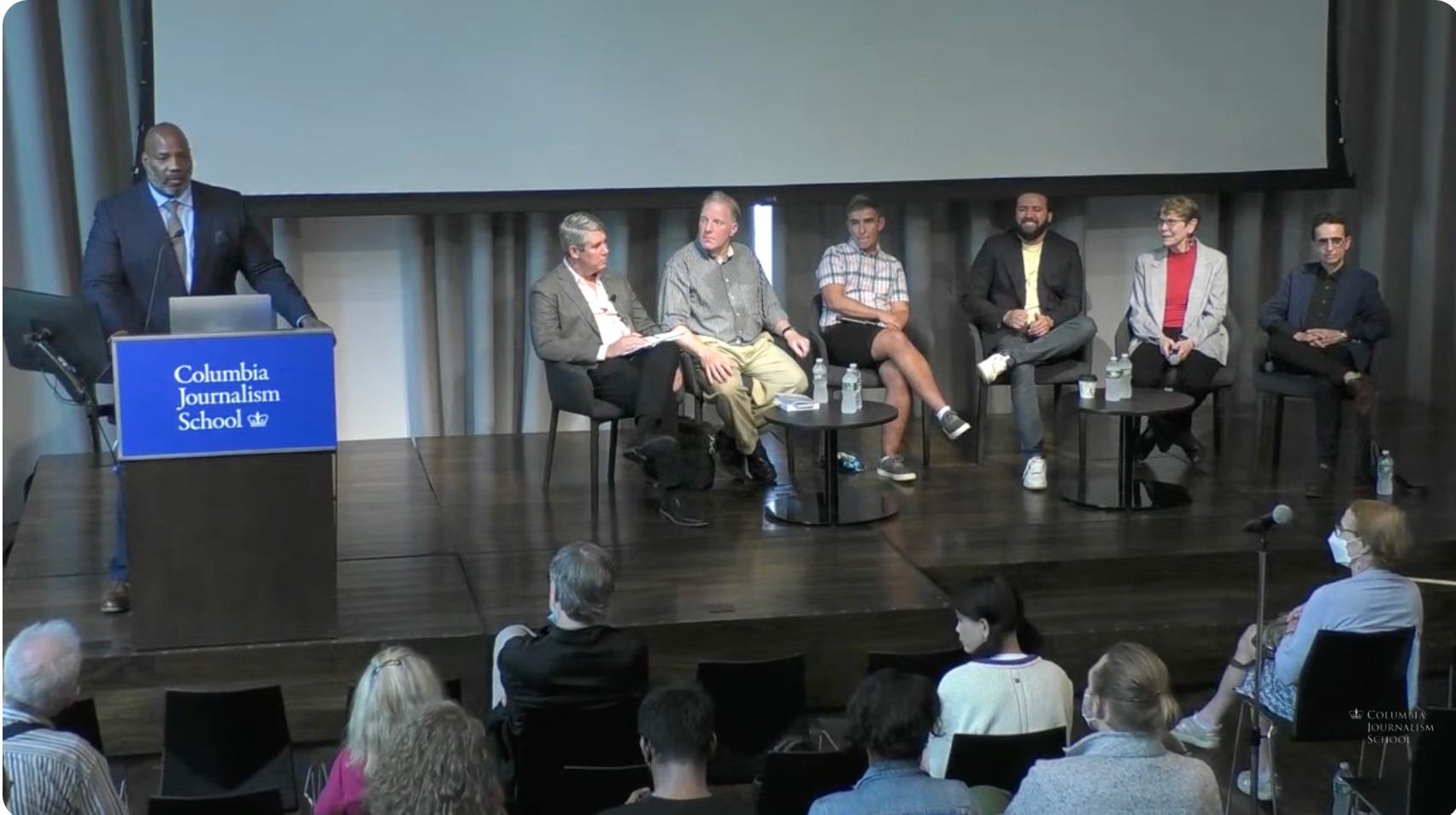
Here is the relevant section of the podcast discussion:
Henley: I want to ask you about something that Wesley Lowery said during the panel. He called newsrooms apartheid institutions and claimed that every single day mistakes get made because newsroom leadership lacks diversity…
Greenberg: Well first, (exasperated sigh), you know, I think it’s wrong to use words like apartheid. That’s sensationalistic. It’s hyperbolic. Apartheid was a legal regime that explicitly consigned blacks in South Africa to an inferior position in all walks of society. Now you could say at one point American newsrooms actively and openly discriminated against blacks. That is no longer the case…
Setting aside Greenberg’s contention that black journalists are no longer “actively” discriminated against in American newsrooms, Henley’s characterization of my remarks seemed off to me and so I went back and rewatched the panel discussion.
Here is the relevant section of my remarks that day:
Lowery: This is an industry that until very recently had completely excluded people of color from its leadership…A lot of what we see playing out is the continued backlash to integration. When we talk about newsrooms and the quote unquote clashes inside of them: the vast majority of American newsrooms were explicitly racially segregated until the 1970s. Most of them did not take real efforts to begin desegregating until the 80s or early 90s at which point there was a massive backlash from the white people who worked in the newsrooms, and then we hit the economic downturns that then purged most of the people of color who had gotten into the newsrooms in the first place. So when we talk about dynamics that are happening within our newsrooms. We have to understand that these are still, essentially, apartheid institutions. These are all-white institutions with a sprinkling of other people who have managed to make their way in over time…
We know that there are almost no mainstream news organizations that reflect the diversity of the places that they ostensibly cover, much less of the nation that they ostensibly cover.
Much like contacting the people you are writing about for comment, accurately quoting people is a foundational building block of “objective journalism.” So is providing the relevant context that a reader or listener needs to have in order to understand the quotation in question.
Here, Henley and Greenberg sort-of pass the first test (“essentially,” a crucial qualifier, gets dropped from their version), but clearly fail the second.
The Jim Crow south and the segregated American north were by any reasonable definition forms of racial “apartheid.” If Henley and Greenberg are unaware of the frequent application of this term to post-Reconstruction American history, perhaps it is because this topic falls outside of their professional expertise.
“We have called it racial discrimination, legal segregation, in a very colorful way ‘Jim Crow.’ I and many others are beginning to prefer the term ‘American apartheid.’” historian Evelyn Hu-DeHart, the director of Brown University’s Center for the Study of Race and Ethnicity in America, explained back in 2007. “We shouldn’t think of apartheid as something only South Africans did and we all protested. Because, in fact, we probably gave the South Africans the idea in the first place about compulsive racial segregation - this period of American history that lasted into the 1960s.”
The earliest it can be argued that American Apartheid came to an end would be 1968. The Rev. Jesse Jackson, an acolyte of Martin Luther King Jr.’s, was referring to “the ending of apartheid in the south” as early as interviews conducted in 1986. In recent decades a number of leading historians and researchers have also used the term to speak of the period that followed Civil Rights -- when black Americans were corralled via housing covenants and ordinances into substandard housing, provided substandard education and public accommodations, and patrolled by often discriminatory and violent policing. When sociologists Douglas S. Massey and Nancy A. Denton published their classic study on the creation of the American urban ghetto, they titled the project “American Apartheid: Segregation and the Making of the Underclass.”
What were American newsrooms like during this era of American Apartheid? They were almost all-white workplaces with just a handful of black journalists.
In the decades since the 1960s, newsrooms that were once explicitly segregated have systematically resisted racial integration. As a result, the staffs of many newsrooms today have statistically insignificant levels of racial diversity, especially at the highest levels of newsroom leadership. As I have written, the mainstream press is incapable of providing the journalism necessary to support a multiracial democracy because the mainstream press has never, itself, practiced multiracial democracy. On the day George Floyd, the Philadelphia Inquirer -- one of our oldest newspapers, and the news outlet of record in a city that is nearly 40 percent black -- had just one black male on its metro staff. Its newsroom has never been led by a black editor.
The Inquirer is not the only newsroom whose number of black journalists remains at pre-Civil Rights Era levels. It is closer to the norm than the exception. One might therefore describe them, in the context of a conversation specifically about integration and newsroom diversity statistics, as remaining “essentially apartheid institutions.” It is not sensationalism. It is a historically grounded description of institutions that have never meaningfully integrated. The terminology is no less accurate just because some people might not like it.
The purpose of this essay is not to litigate a three-year-old reference to apartheid. Although, I will admit, listening back to this section of the Columbia conversation I was pleased to discover I’d extemporaneously invoked the term in a less glib and more properly caveated way than I feared I might have.
Similarly, I was happy to find that, for the most part, I expressed myself and my beliefs clearly and dispassionately. Henley told me she consulted the recording of this panel discussion in the writing of her forthcoming book. We’ll see if what I said that day, more of which I’ll quote in closing, is accurately represented in her book or if this will be yet another instance in which I am presented in an unrecognizable way incongruent with objective reality.
Lowery: I don’t actually think that, when properly defined, very many people disagree with the concept of journalistic objectivity -- because when properly defined it is completely anodyne…But…this journalistic, scientific style…even if we accept that premise, from its very inception that is not how it has been used…Objectivity has always been wielded to silence people who do not fit with the politics of the people who own and operate the newspapers. It has always been a censorious force, never an expansive force…Powerful white journalists have shown us for a century that they don’t believe anyone but themselves can be objective…It’s one of the reasons none of these newsrooms can integrate, because they keep running every person who is not them out.
All of those observations remain true. The argument I made that evening was not radical, or even original. Four years later, it remains unanswered.
I’m still looking forward to reading Henley’s book. And from what I can tell, it seems to be arguing for a return to more rigorous, methodical reporting -- which is what I’ve called for all along. Still, if she and others are going to appoint themselves the defenders of objective journalism, they should practice what they preach. Otherwise, they are just the latest set of journalistic gatekeepers proclaiming one thing, doing another, and pushing out of the industry anyone who dares disagrees. That is a recipe for continued mistrust for years to come.
love this